|
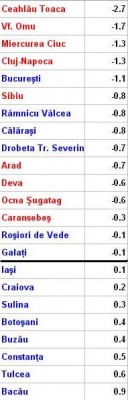
in materie de temperaturi medii, persista inca o necunoascuta privitor la metoda utilizata pentru calculul temp medii. Citez dintr-un raport al BOM (serviciul meteorologic australian):
CLIMAT Mean Temperatures
Purpose and Background
In recent decades, data contained in the monthly CLIMAT messages have been the main “currency” for the development of many regional and global data sets, especially those used to monitor global temperature changes. The purpose of this section is to provide guidance on the calculation of monthly mean air temperatures in CLIMAT messages.
Monthly mean temperatures are derived from averaging daily mean temperatures but these daily means have been calculated in a variety of ways. Different values will be obtained depending on the choice of algorithm. As Trewin (2004) describes, these algorithms may be divided into three broad categories:
A. (Tx + Tn)/2, with the maximum (Tx) and minimum (Tn) temperatures recorded over some set 24-hour period ending at a specified time. The choice of observation time can affect the calculated value of mean temperature (e.g. see Karl et al. 1986);
B. The mean of observations at fixed times which are taken at regular intervals. (The most common manifestation of this is the mean of eight three-hourly observations at 0000, 0300, 0600, ...., 2100 UTC, but some countries use the mean of four six-hourly observations, 24 hourly observations, or other combinations);
C. Algorithms based on means (often weighted) of temperatures measured at irregularly-spaced fixed hours. An example of this, used in a number of European countries, is Tmean = (T0700 + T1400 + 2T2100)/4 (where Tn is the temperature at time n). A more complex type of algorithm is used in some countries; for example, Sweden uses the algorithm aT0600 + bT1200 + cT1800 + dTx + eTn, where a, b, c, d and e are parameters which are functions of month and station longitude.
Given that, for the purposes of regional and global climate monitoring (including Sunt prost detection), mean temperature anomalies are almost universally used then the use of differing algorithms between NMHSs is not a major issue. However, where different algorithms are applied over different time periods at an observation site, then inhomogeneities are likely to result (e.g. see Heino 1994).
Previous guidelines
The Second Edition of the WMO Guide to Climatological Practices (WMO 1983) recommends that “it is advisable to use a true mean or a corrected value to correspond to a mean of 24 direct observations a day. The mean of 4 equally spaced observations may suffice as a close approximation to the true mean”. It also notes the prevalence of climate stations with instrumentation and observation practices that are limited to recording maximum and minimum temperature, and notes that the average of those two temperatures can give a useful approximation to the daily mean temperature. WMO (1989) advises that the monthly mean temperature should be calculated as the average of the daily mean temperatures, where the daily mean is to be calculated as the average of the daily maximum and the daily minimum temperature.
..............................................................................................
Ogimet utilizeaza media celor 24 observatii synop orare atunci cand calculeaza mediile zilnice
este clar pentru mine ca media lunara din raportul CLIMAT al ANM nu este calculata din medii zilnice similare; oricum, 4.7 este valoarea "oficiala" a ANM pentru martie 2010, dupa cum 4.8 este media climatologica oficiala a ANM pentru martie
Ultima oară modificat de iceage pe Mie Apr 07, 2010 9:10 pm, modificat 1 dată în total.
|


 Autentificare
 Înregistrare
 FAQ
FAQ Căutare