The team first confirmed a theory that the slight increase in solar energy during the peak production of sunspots is absorbed by stratospheric ozone. The energy warms the air in the stratosphere over the tropics, where sunlight is most intense, while also stimulating the production of additional ozone there that absorbs even more solar energy. Since the stratosphere warms unevenly, with the most pronounced warming occurring at lower latitudes, stratospheric winds are altered and, through a chain of interconnected processes, end up strengthening tropical precipitation.
At the same time, the increased sunlight at solar maximum causes a slight warming of ocean surface waters across the subtropical Pacific, where Sun-blocking clouds are normally scarce. That small amount of extra heat leads to more evaporation, producing additional water vapor. In turn, the moisture is carried by trade winds to the normally rainy areas of the western tropical Pacific, fueling heavier rains and reinforcing the effects of the stratospheric mechanism.
Earth's response to the solar cycle continues for a year or two following peak sunspot activity. The La Nina-like pattern triggered by the solar maximum tends to evolve into a pattern similar to El Nino as slow-moving currents replace the cool water over the eastern tropical Pacific with warmer water. The ocean response is only about half as strong as with El Nino and the lagged warmth is not as consistent as the La Nina-like pattern that occurs during peaks in the solar cycle.
Enhancing ocean cooling
Solar maximum could potentially enhance a true La Nina event or dampen a true El Nino event. The La Nina of 1988-89 occurred near the peak of solar maximum. That La Nina became unusually strong and was associated with significant changes in weather patterns, such as an unusually mild and dry winter in the southwestern United States.
The Indian monsoon, Pacific sea surface temperatures and precipitation, and other regional climate patterns are largely driven by rising and sinking air in Earth's tropics and subtropics. Therefore the new study could help scientists use solar-cycle predictions to estimate how that circulation, and the regional climate patterns related to it, might vary over the next decade or two.
Three views, one answer
To tease out the elusive mechanisms that connect the Sun and Earth, the study team needed three computer models that provided overlapping views of the climate system.
One model, which analyzed the interactions between sea surface temperatures and lower atmosphere, produced a small cooling in the equatorial Pacific during solar maximum years. The second model, which simulated the stratospheric ozone response mechanism, produced some increases in tropical precipitation but on a much smaller scale than the observed patterns.
The third model contained ocean-atmosphere interactions as well as ozone. It showed, for the first time, that the two combined to produce a response in the tropical Pacific during peak solar years that was close to actual observations.
"With the help of increased computing power and improved models, as well as observational discoveries, we are uncovering more of how the mechanisms combine to connect solar variability to our weather and climate," Meehl says.
Acum in romnia, de 1 an vad ceva stupid toamna, apune soarele iar dupa apus apare galben foarte tipator si in partea inversa a apusului negrul noptii si imaginea ramane asa veo 17 min dupa care se albastreste si se face noapte. Si am ceva experienta in apus si rasarit de soare inca din 2001.
Mai am o anomalie de notat care mi-a spus-o bunicamea, 1955 a avut ger in bucovina si spre sfarsitul lunii martie. In sud era cald. Sau ce mai povesteste ea in 1976 la mare aia radeau de bucuresteni ca e soare si la noi ningea calumea. Si culmea la mare nu a nins, ci norul cu viscolul sa dus in moldova. Cine mai are acces la hartile de atunci s-o puna aici sa revedem imaginea.
Deci Anomaliile se produc pe maximul ciclului solar, iar cand soarele diceteaza influente magnetice apai pe toate planetele incepe zgudutremureanu sa scuture. Ce zicea Mister juvete Marmureanu de ne-a inchis gurile la toti? "Anul acesta s-au produs foarte multe cutremure de peste 7 grade in lume, ceea ce a dat peste cap normalul pentru un an de zile, adica 1 pana la maxim 3 cutremure de putere."
Si daca rasfoim noaa o sa vedem K solar ca a atins 5 si 6 anul acesta de cateva ori, deci normalul se transofma in anormal.
Zapada ciclului solar 19,
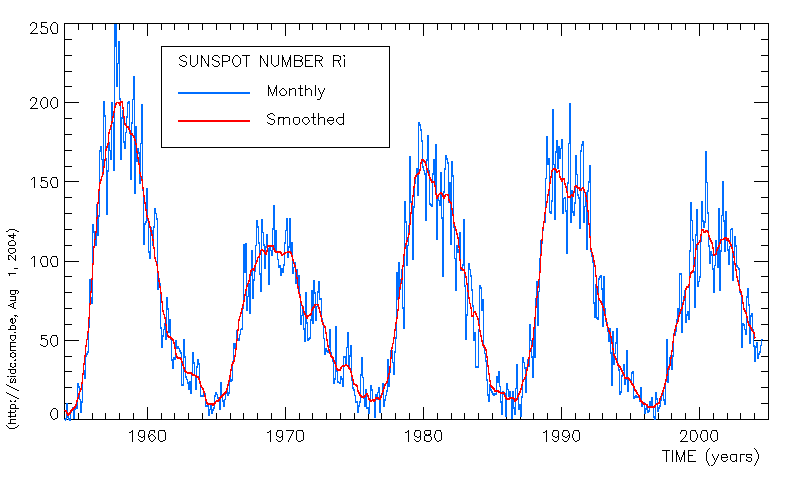
a fost anomalie. Zapada lui 2012 fiind pe ciclu solar si asta a fost anomalie. Ne putem astepta si la mai multe teribilisme daca soarele da explozii bune. Pe radio se stie clar ca anii 30 au fost cei mai isterici urmat de mega 54-56 care a facut praf mai multe statii repetor de telefonie si a distrus in totalitate transformatoare, futunile au fost empirice de ziceai ca e poveste, mai stie cineva de inundatiile dambovitei in bucuresti acelea de pe vremuri, eu da, le metre spre iesirea de la vacaresti padurari. Gandim logic caldura aceea mult mai mare a soarelui care o emite afecteaza orice. Mai ales cand a fost explozia solara cu notatie X1 si imediat la 2 zile auzeai ca ceva sa petrecut in lume.


 Autentificare
 Înregistrare
 FAQ
FAQ Căutare


 Nu uit cum ma tot duceam in weekend-uri la recuperari ca se inchideau scolile.
 Radiatia solara de martie a facut stratul tandari in cateva zile.


